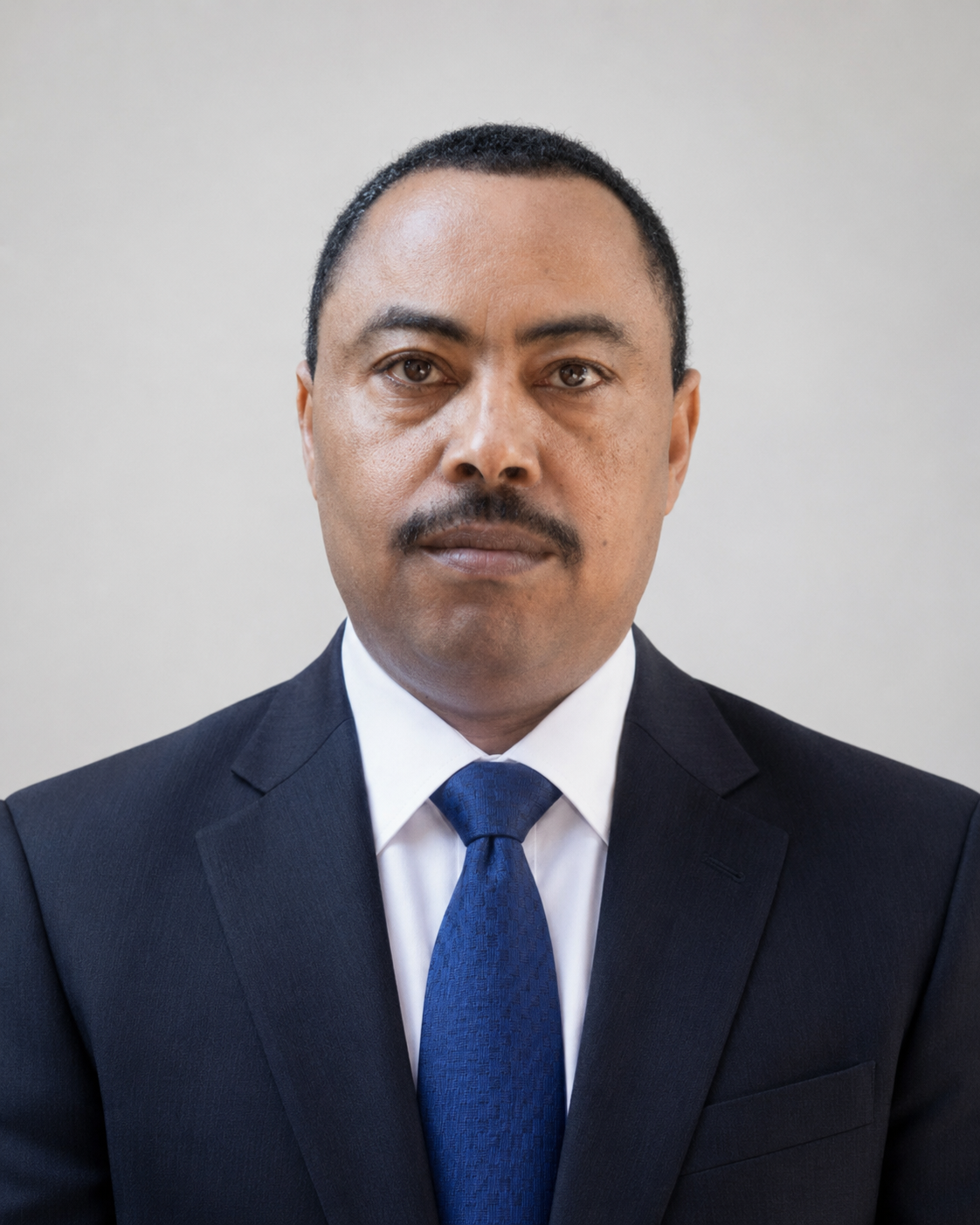
Engineering, Leadership and Water Resources
Dr. Eng. Mitiku Bedru Gochefo is a hydraulic and irrigation engineer, water-resources professional, institutional leader and senior government adviser whose career has evolved from practical irrigation design and field engineering into university teaching, engineering consultancy management, water-sector leadership, international development cooperation and high-level public-policy engagement.
Over more than three decades, his professional life has remained closely connected with irrigation, water resources, infrastructure development, integrated water-resources management, Water, Sanitation and Hygiene (WASH), agricultural development, institutional capacity building and public-sector leadership.
His professional journey began at the Arba Minch Water Technology Institute (AWTI), where he studied Irrigation Engineering and graduated with a Bachelor of Science degree in 1995. During this formative stage, he worked with Mesfin Hagos, Seid Shimelis and Tamir Mitiku on the HARE Irrigation Project Design Report.
Irrigation Design, Rural Infrastructure and Field Engineering
Immediately after graduation, Dr. Mitiku entered professional practice as a design engineer involved in the study and design of small-scale and micro earth dams and irrigation infrastructure with the Commission for Sustainable Agriculture and Environmental Rehabilitation in Amhara Region (CO-SAERAR).
He subsequently joined the Commission for Sustainable Agriculture and Environmental Rehabilitation for the Southern Administrative Region, where his responsibilities expanded into irrigation-potential assessment, reconnaissance, pre-feasibility and feasibility studies, detailed design of small-scale irrigation schemes, rural water-supply and sanitation assessments, food-security programmes and broader infrastructure-development activities.
These assignments gave him practical exposure to the complete early stages of infrastructure development—from field reconnaissance and resource assessment through feasibility investigation, irrigation planning and hydraulic design—and broadened his understanding of irrigation beyond structures alone to include management, institutions, communities and long-term sustainability.
Specific Study, Design and Development Assignments
To make his engineering record more explicit, selected projects and assignments from different stages of Dr. Mitiku's professional development include the following:
HARE Irrigation Project Design Report — Ethiopia, 1995
Member of the original four-person Arba Minch Water Technology Institute team that prepared the HARE Irrigation Project Design Report, integrating hydrology, crop-water requirements, irrigation planning, canal hydraulics, diversion works and hydraulic structures.
Alduba Small-Scale Earth Dam — Southern Ethiopia
Participated in the identification and feasibility study of the Alduba small-scale earth dam during his early professional practice in irrigation and rural infrastructure development.
Diversion Irrigation Projects — Southern Ethiopia
Worked on the study and design of several diversion-irrigation schemes as a design engineer and later as a study-team leader, covering reconnaissance, feasibility assessment, irrigation planning and hydraulic design.
Small Bridge Projects — Dawro Zone, Southern Ethiopia
Led the study and design of a number of small bridge projects, extending his early engineering practice beyond irrigation into local rural infrastructure.
Integrated Bura Land and Water Development Project — Kenya
While studying at IHE Delft, participated in the preparation of a pre-feasibility study for a major land-and-water development project involving approximately 14,500 hectares of irrigated agriculture.
Kuraz Sugar Development Project — Ethiopia
Contributed to the preparation and finalization of proposals associated with one of Ethiopia's major agro-industrial development programmes, with a planned net irrigable area exceeding 150,000 hectares.
Delft, Sustainable Irrigation and Engineering Education
Dr. Mitiku completed an M.Sc. in Hydraulic Engineering with specialization in Land and Water Development at the International Institute for Infrastructural, Hydraulic and Environmental Engineering (IHE), Delft, the Netherlands, in 2003. His Master's research examined design, operation and maintenance measures for sustainable small-scale irrigation schemes in South Ethiopia.
While at IHE Delft, he also participated in preparation of a pre-feasibility study for the Integrated Bura Land and Water Development Project in Kenya, involving approximately 14,500 hectares of irrigated agriculture and collaboration with international professionals.
Following his return to Ethiopia, he taught civil and hydraulic engineering subjects at the institution now known as Hawassa University and later served as Head of the Civil Engineering Department, contributing to academic development, engineering education and institutional capacity.
From Individual Projects to Regional Development Programmes
From 2006 to 2008, Dr. Mitiku served as Vice Bureau Head responsible for Irrigation Development within the SNNPR Water Resources Development Bureau, and from 2008 to 2010 he served as Head of the Bureau of Water Resources Development.
His responsibilities extended across irrigation development, water supply and sanitation, integrated water-resources management, basin development, mines, rural energy, off-grid electrification and related development programmes. This marked a major transition from designing individual schemes to leading regional water and infrastructure programmes.
He later became General Manager of the South Design and Construction Supervision Enterprise, where he managed engineering consultancy, study, design, construction supervision and multidisciplinary infrastructure activities, including work associated with major development proposals such as the Kuraz Sugar Development Project.
WASH, Small-Scale Irrigation and Human Capacity
Dr. Mitiku's experience broadened through international development cooperation when he served as a WASH Adviser with SNV Ethiopia under the Netherlands–UNICEF WASH Initiative, coordinating stakeholders and supporting capacity development at regional, district, school and community levels.
Between 2015 and 2020, he served as National Regional Team Leader for the Small Scale and Micro Irrigation Support Project (SMIS) with Agriteam Canada Consulting Ltd. The programme supported institutional and professional capacity for small-scale irrigation (SSI) and household micro-irrigation (HHMI), climate-resilient irrigated agriculture, agricultural-water management, extension systems, market linkages and irrigation training.
An important component of this work was the development of curricula and demonstration facilities for practical training of Irrigation Development Agents at ATVET colleges, strengthening not only irrigation infrastructure but also the human capacity required to operate and sustain it.
Water Policy, Climate Resilience and International Relations
In 2021, Dr. Mitiku served as Adviser to the SNNPR Government on irrigation and watershed-development affairs while concurrently serving as General Manager of the Southwest Ethiopia Peoples Referendum Project Office. From late 2021 until 2025, he served as Adviser to the President of the Southwest Ethiopia Peoples Regional Government on Economic and Infrastructure Affairs.
In June 2025, he moved to the Ministry of Water and Energy of the Federal Democratic Republic of Ethiopia as Senior Adviser to the Minister on Foreign Relations. In this national-level position, he provides high-level advisory and facilitative support, contributes to sector-programme development, supports coordination among government institutions, regional agencies and development partners, and helps strengthen Ethiopia's regional and international cooperation in the water and energy sectors.
His assignments also extend to regional programmes. He serves as a representative of the Ethiopian Project Advisory Committee (PAC) of the AUDA–NEPAD MPA WASH Programme for Eastern and Southern Africa, providing strategic support and oversight and helping to align regional programme activities with national water- and sanitation-sector priorities.
He additionally serves as the Ministry's focal person for the African Union Commission Climate-Resilient Water Investment Programme and its associated project-pipeline development, positioning his current work at the intersection of national water policy, African regional cooperation, climate resilience and international water investment.
Engineering, Institutions and Sustainable Water Development
Throughout his career, Dr. Mitiku has combined the perspectives of an engineer, university teacher, engineering manager, programme leader, institutional developer and public-policy adviser.
His professional development has included training and international exposure in integrated water management, river-basin management, ecosystem considerations in Integrated Water Resources Management (IWRM), procurement and contract management, geographic information systems (GIS), AutoCAD and results-based project-cycle management.
He later pursued doctoral studies in Leadership, focusing his research on leadership styles associated with the sustainability and profitability of community-managed small-scale irrigation schemes. He earned his PhD in 2023 from Vision International University, USA, through its affiliation arrangement involving the Grace Graduate School of Grace International Leadership & Theological University (GILTU) in Addis Ababa.
His work demonstrates how a career rooted in hydraulic design can progressively expand to include agricultural development, institutional capacity, governance, public administration, climate resilience and regional cooperation.
Where the Journey Began
Within this broad professional history, the HARE Irrigation Project occupies a special place. Prepared in 1995, when Dr. Mitiku was a young Irrigation Engineering student at Arba Minch Water Technology Institute, it represents one of the earliest expressions of the technical discipline and professional commitment that would remain central throughout his career.
From studying and designing small irrigation systems and earth dams, he progressed to leading regional irrigation-development programmes. From learning the principles of hydraulic structures, he advanced to directing water-resources institutions and engineering consultancy organizations. From analysing irrigation schemes primarily as engineering systems, he later examined the leadership, governance and institutional arrangements required to sustain them.
Revisiting the HARE Irrigation Project more than three decades later therefore brings together the young irrigation engineer who participated in its original design and the experienced hydraulic engineer, institutional leader, scholar and senior government adviser whose responsibilities now encompass water governance, climate-resilient investment, regional development and international cooperation.
Bringing the project back into print therefore connects engineering education with professional experience, and past calculations with present understanding.